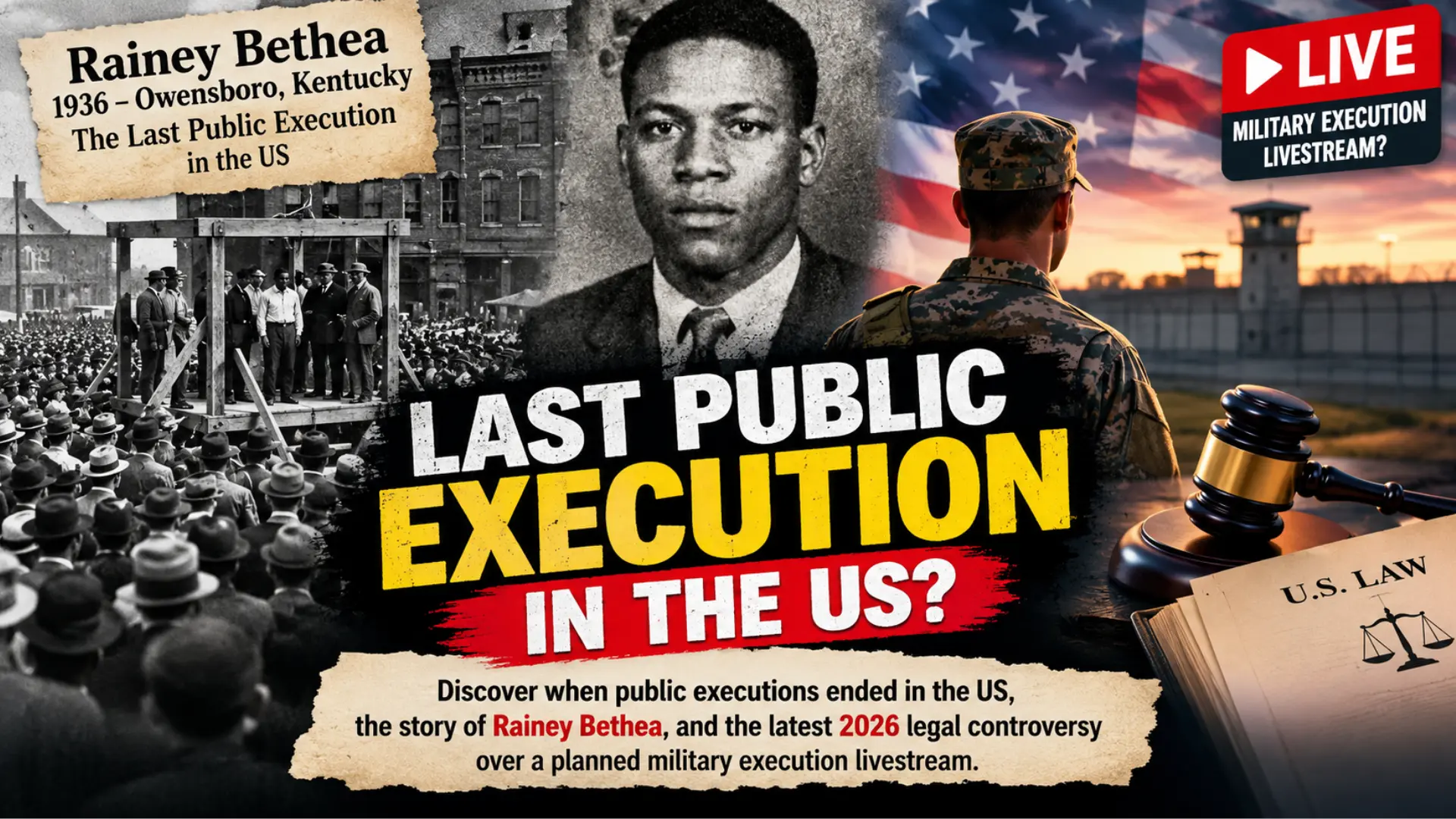
Introduction
The last public execution in the US is still an intriguing topic because it links American history, criminal justice, and current legal debates. For centuries, large crowds occasionally watched the executions. But the United States, over time, moved to carrying out executions inside prisons, away from the public.
Now, it’s October 2026, and the subject is back in the news. Reuters reports the Pentagon plans to livestream the scheduled firing-squad execution of Nidal Hasan, the former US Army psychiatrist convicted in the 2009 Fort Hood shooting. The execution is set for Dec. 3, 2026, although court action could change the date. Read the Reuters story here.
This development raises an important question: Are public executions legal in the US, or has the practice been permanently abandoned?
Here are the facts about the history of public executions, the last publicly announced hanging, the present-day legal restrictions, and the latest in 2026.
Latest News on Public Executions in the US: October 2026
The biggest new wrinkle is the U.S. military’s decision to air an impending execution on television.
Reuters reported on October 9, 2026, that the Pentagon will broadcast the planned execution by firing squad of Nidal Hasan live. In 2013, a military court convicted Hasan of the 2009 Fort Hood, Texas, shooting that killed 13 people.
The announcement has raised questions as to whether current laws and military regulations permit public broadcasting of an execution.
Key points from the latest reporting include:
- Scheduled date: December 3, 2026.
- Planned method: Firing squad.
- Person involved: Nidal Hasan, a former Army psychiatrist convicted in the Fort Hood case.
- Main legal question: Whether military authorities can livestream an execution despite restrictions that apply to recordings and broadcasts of federal prison executions.
- Current status: The execution is planned, not completed, and legal challenges could delay it.
The difference between civilian executions matters a lot. Federal prison rules say that you can’t record or show executions on TV or online.. Military executions have different rules. The question of whether the live stream can happen legally is an issue, from whether using a firing squad is allowed.
Source: Reuters — Is it legal for the US to livestream the Fort Hood shooter’s execution?
What Was the Last Public Execution in the US?
The hanging of Rainey Bethea on August 14 1936 in Owensboro, Kentucky is widely recognized as the public execution, in the United States.
Bethea was a Black man who was found guilty of rape. His story drew a lot of interest and many thousands of people were said to have come to see the hanging.
Historical records say that up to 20,000 people might have come to the execution site. Different sources give different numbers.
Betheas hanging became a turning point in the story of executions because it showed the problems of making state punishment a public show.
Some people had defended hangings as a way to stop crime.. The crowds, the chaos, the selling of tickets and deeper moral worries about these shows made more people oppose public executions.
The Bethea hanging is now remembered by many as the end of the era of public executions, in America.
For historical background, see the Death Penalty Information Center and Louisville Public Media’s 2026 report.
When Did Public Executions End in the US?
Public executions largely disappeared in the United States during the first half of the 20th century.
The transition did not happen overnight. States gradually moved executions behind prison walls, limiting attendance and introducing procedures intended to control the event.
The following timeline provides useful historical context:
| Period | Historical development |
|---|---|
| 18th and 19th centuries | Public executions were used in many places, often attracting large crowds. |
| Late 19th century | More states began requiring executions to take place inside prisons or private enclosures. |
| August 14, 1936 | Rainey Bethea was publicly hanged in Kentucky. |
| 1937 | A public hanging in Missouri is also documented in historical accounts, complicating claims about the exact final event. |
| Mid-20th century onward | Executions increasingly became restricted events conducted inside correctional facilities. |
| October 2026 | A planned military execution livestream renews the debate over public access and broadcasting. |
Important historical distinction: The Rainey Bethea hanging in 1936 is widely described as the last public execution in the United States. Some legal and historical accounts also mention a public hanging in Missouri in 1937. For accuracy, it is best to describe Bethea’s case as the last widely recognized public execution rather than claiming that every historical account agrees on the exact final event.
Are Public Executions Legal in the US?
The answer depends on what’s meant by a public execution.
The United States still allows punishment under some federal and state laws. However todays executions usually happen inside prison buildings. Only certain people are allowed to be there.
There is a difference between whether the death penalty is allowed and whether it is allowed for the public to watch.
The death penalty is still legal in some parts of the United States. That does not mean that governments have the right to hold executions in public or to show them live, to the public.
Several legal issues may apply:
- State laws and correctional regulations govern access to state executions.
- Federal prison rules prohibit recording or broadcasting federal executions.
- Military executions may be governed by separate rules.
- Courts have considered whether journalists and the public have a constitutional right to observe executions or access recordings.
The 2026 military livestream is planned so these distinctions become especially important. The legal question is not merely whether an execution is permitted. Whether the authorities have the power to allow the military livestream to be publicly viewable.
For additional information, consult the US Bureau of Prisons’ federal execution information and the US Department of Justice.
Is Public Execution Legal in the US in 2026?
I have learned that as of October 9 2026 the public does not have a right to attend or watch every execution in the United States.
I know that executions usually happen in controlled settings. Designated witnesses, certain officials, legal representatives and approved members of the media can usually access them following the applicable rules.
I see that the planned Hasan livestream brings up a legal issue because military regulations do not always match the rules that govern executions in federal civilian prisons.
I think that it would be wrong to say that the announcement makes public executions generally legal across America. Every decision must be checked against the laws and regulations that govern each execution.
I believe that courts may also be asked to look at issues about the broadcast, access to proceedings and legal challenges to the sentence.
I expect that the final legal position about the planned livestream may change if there are developments, before December 3 2026.
Why Did Public Executions Stop in America?
Several historical and practical factors contributed to the decline of public executions.
1. Public order and crowd control
Large crowds often caused trouble, near execution sites. People would gather, drink, buy things and try to get souvenirs.
Officials started preferring managed settings instead of big public events.
2. Changing attitudes toward punishment
Over time people who hold positions experts who talk about the law and regular citizens discussed whether it was right for executions to be seen by large groups of people.
The move toward executions showed a bigger change in the way governments carried out punishments, for crimes.
3. Prison-based procedures
Moving executions inside prisons made it easier for the people, in charge to manage where the executions happened who was there and how everything was done.
It also made it less likely that a lot of people would gather near the place where the execution took place.
4. Ethical and legal concerns
Public executions bring up questions, about human dignity, the role of the state and if people should be allowed to watch someone die.
The 2026 livestream announcement has brought these standing debates back into public discussion.
Public Executions vs. Private Executions: What’s the Difference?
| Feature | Public execution | Modern restricted execution |
|---|---|---|
| Location | Historically, an outdoor site or public gathering place | Usually inside a prison or another authorized facility |
| Audience | Potentially large crowds | A limited group of authorized witnesses |
| Public access | Open to members of the public | Restricted under applicable rules |
| Recording or livestreaming | Historically not applicable in the modern digital sense | Subject to specific legal and regulatory restrictions |
| Main debate | Public spectacle and deterrence | Transparency, privacy, accountability, and legal access |
A livestream allows an event to be seen by people without needing to let the public into the actual location. That difference is key, to the 2026 controversy.
Could the 2026 Livestream Become the First Public Execution in Decades?
If the Pentagons announced plan proceeds the livestream would be a change from the old way of keeping US military executions away from most online viewers.
However there are differences that matter.
First a livestream is not the same as letting people come to the execution site in person. Second the Pentagons announced plan does not prove that the execution will definitely happen on the scheduled day. Third rules for executions and civilian executions are not the same.
Because of these points the best way to describe it is that the planned broadcast could become the time a modern US military execution is shown to the public depending on legal challenges and other future events.
Readers should keep an eye on reporting, for new information instead of treating the announced date as a finished event.
Conclusion
The last public execution in the United States is widely linked to Rainey Bethea’s hanging in Owensboro, Kentucky on August 14 1936. While a few historical records mention another public hanging in Missouri in 1937 the Bethea case remains the recognized example marking the end of public executions in America.
In 2026 the topic has resurfaced in the news because the Pentagon has said it plans to livestream the execution of Nidal Hasan. This idea brings up questions about who should have access to such events whether broadcasting should be allowed, the limits of military power and how capital punishment is carried out today.
The key point is that even if the death penalty is legal that does not mean public executions or live broadcasts of them are automatically allowed. What happens will depend on the rules in place. Any court rulings that may come up.
As this story continues readers should keep in mind the difference, between what happened in the past what is being proposed now. What has actually been decided by law.